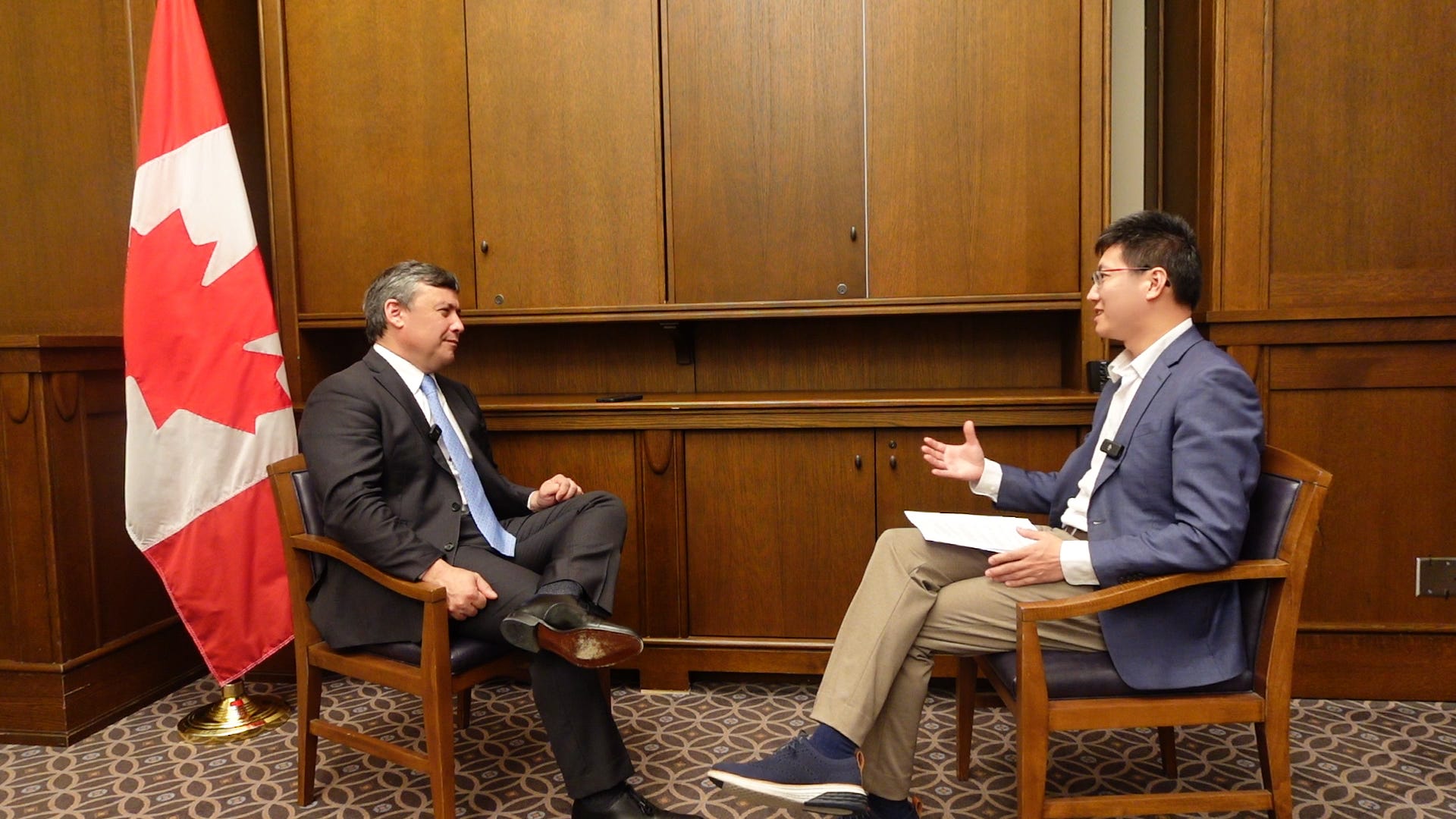
An Exclusive Interview with MP Michael Chong, Canada’s Shadow Minister for Foreign Affairs 專訪加拿大影子外交部長莊文浩
公子訪談
中文版在本頁下方
Q: Michael, thank you for your time today. Let’s dive right into it. You’ve just returned from Taipei, where you met President Lai. A trip you made after China’s ambassador publicly warned Canadian MPs to stay away. Why was it important to you to go anyway and to go now?
A: Well, it was important to go for two reasons. As you know, Taiwan is a democracy on the front lines of authoritarian threats from an authoritarian state. And I think it’s important for democracies like Canada to show solidarity with those democracies.
We show our solidarity with Ukraine. Taiwan is in some ways, no different. It’s another democracy facing threats from a different authoritarian state. And so I think it’s important to show solidarity. The second reason?
That it was important to go is because of the PRC ambassador’s recent comments that Canadian MPs no longer travel to Taiwan, despite longstanding practice of the last five decades where MPs from all parties have traveled to Taiwan to foster bilateral relations. The ambassador also made another outrageous comment.
He indicated that he warned against Royal Canadian Navy warships from transiting through international straits, such as the Taiwan Strait, and said that Canadian warships should no longer transit through the Taiwan Strait. even though it’s an international strait, and even though they’ve done so a dozen times in the last several years.
Q: So you bought the tickets right after he made that comment?
A: Yeah, I think it’s important. I made the decision. That action speaks louder than words, and that sovereignty is not just something that you proclaim, it’s something you have to exercise.
This is why our Navy warships transit through international waters to maintain global commerce and open shipping lanes. It’s why MPs travel abroad for bilateral visits. So I decided to not just assert our sovereignty by issuing a statement, but also to exercise it by visiting Taiwan.
Q: He is probably going to regret about that.
A: I agree. And I think one of the things that came out of the trip was that. It prompted the Government of Canada to issue a statement in support of Canadian MPs traveling to Taiwan.
And it’s also prompted MPs like Judy Sgro to make it clear that they are also planning to go to Taiwan in the near future. So I think those were the things that came out of the trip that I was happy to see.
Q: In 2021, you were sanctioned by Beijing. And you later learned that the Chinese government had targeted your relatives in Hong Kong because of your work in Parliament. What was it like to discover that? And what did it teach you about how the Chinese state views people of Chinese descent and also any Canadian who’s critical of China?
A: As you pointed out, Beijing sanctioned me for not anything that I did. They’re ostensibly their reason for sanctioning me was because of some actions the Government of Canada took.
Earlier in March of 2021. And so they sanctioned me for decisions that the Government of Canada made. And subsequent to that, as you pointed out, one of their diplomats here was clandestinely collecting information on me and my family to submit.
Not to the Ministry of Foreign Affairs of the People’s Republic of China, but to their secret police, to the Ministry of State Security. And that was for potential future targeting of family that I have in China. So my feeling is that this has exposed.
What is a broad practice of Beijing in democracies, where they use transnational repression, coercive tactics, clandestine tactics to try to intimidate citizens of those democracies? Into silence? I’ve got the fortunate position of being an elected member of Parliament.
Where I can raise these issues. But there are so many members of the community that suffer in silence because they don’t have a voice. Their cases are not publicly known, and yet they’re subject to this transnational repression.
So I feel a responsibility, a duty to make this kind of repression public, to be a voice for the voiceless.
Q: You’ve described Taiwan as a democracy at the front lines of threats from authoritarian states. You just said that. You said it before. What did you see on the ground in Taiwan that during the trip, that you wish more Canadians could see for themselves?
A: What I saw was a prosperous society that protects civil liberties and rights. That also respects the rule of law and has an independent judicial system and a society that is democratic in nature. where power has changed between two different parties, where the president and office changes through democratic elections. That’s what I saw.
And what that, I think, is really revealing is that. These basic principles of our democracy, of democratic institutions and elections, of freedoms and liberties and civil rights, of the rule of law and independent judicial systems.
Is not just for the democracies of North America and Western Europe. That these are universal principles that the people around the world can aspire to. and the Taiwanese have, and I think have shown tremendous gains over the last several decades. In fact, if you look at Taiwan’s emergence.
As a full-fledged democracy, over the last two, three decades, it’s not only become a full-fledged democracy, it’s also skyrocketed in per capita GDP and prosperity. Its per capita GDP now is higher than ours in Canada. which I think is a testament to these underlying principles.
Q: In Janurary, two Liberal MPs cut their Taiwan visit short on government advice to so-called avoid confusion with Canada’s foreign policy. and you did the opposite. What is at stake when Canada’s government and its parliament send the world two different signals on Taiwan?
A: I think that was an unfortunate incident. I think it signaled the wrong message, both to Taiwan and to Beijing. I think it signaled that the Canadian government was willing to acquiesce to Beijing’s demands on Taiwan.
And I don’t think we should be doing that. I think what’s really important in the Indo-Pacific region is to maintain peace and stability. And I think we maintain peace and stability across the Taiwan Strait. By making it clear to Beijing that there will be a price paid.
For any unilateral action taken by Beijing against Taipei. And so I think in that context, it’s really important that we assure that high price. And that high price is assured through parliamentary visits from democracies’ elected representatives to their counterparts in Taiwan.
It’s assured through freedom of navigation operations that are conducted by various democracies’ navies through the Taiwan Strait. It’s assured by a myriad of other daily and monthly and yearly activities that take place.
Between the democracies of the West and Taiwan. And so I think it’s incredibly important to maintain that pace and tempo of those relations. In order to assure that high price and to make it clear to Beijing.
That there will be a very high price to be paid if any unilateral action is taken against Taipei.
Q: It seems a wrong signal that Canada is willing to give up its principle just for some agriculture purchase. That’s really dangerous.
A: Yeah, I think there’s two lessons to be taken from recent conflicts. The most recent one is what happens when a major global shipping lane is closed. The Strait of Hormuz has been closed now for several months, and it has disrupted global energy markets.
If the Strait of Taiwan were ever to be closed because of some unilateral action by Beijing, it would have a massive impact on trade and investment here in Canada and across North America and Europe. So we have to make sure that that doesn’t happen.
The other conflict that has broken out in recent years, that demonstrates why we have to maintain a very high price against. Any unilateral action by Beijing is Russia’s war against Ukraine. Russia took unilateral action to invade Ukraine just over four years ago. And in the blink of an eye.
Tens of billions of dollars of investment and trade evaporated. And the disruption to global trade has been enormous. And the disruption continues to this day. Over four years later, because of Russia’s war in Ukraine. So the impact of disruption by the PRC against Taiwan?
Would be many fold greater because China is a much, much bigger part of the global economy compared to Russia. which is why we have to work with democracies like Japan, like the Philippines.
Like Taiwan, to ensure that we maintain peace and security in the region. And that begins by not acquiescing to Beijing’s demands about changing the way we have done things for many decades in the region.
Q: So the last question is also about China and Taiwan. And if you could put several specific actions on Prime Minister’s desk tomorrow to strengthen Canada’s relationship with Taiwan and also to deal with China, what would that be?
A: Well, the first thing I think the government should do is sign the Canada-Taiwan trade arrangement. That trade agreement or arrangement was negotiated over a year ago.
The negotiations concluded over a year ago, some 15 months ago. It’s ready for both parties to sign. And I think the government should get on with it and sign that agreement. So we can broaden and deepen trade and investment between Canada and Taiwan. I think the other thing the government should do.
Is try to increase trade with Taiwan by investing in trade missions and trade commissioner services to increase two-way trade and investment between Canada and Taiwan. We have a significant trade deficit with Taiwan. And I think we can do a better job of facilitating trade flows between Canada and Taiwan.
Q: I want to add one more question for my friends in Falun Gong. They just experienced a bomb threat in Toronto. Also, National Arts Center canceled their show, which is going on for 18 years, two decades.
What’s your view on that? What Canada should do about it?
A: I don’t know exactly who’s behind these bomb threats. But it is consistent with the tactics that the PRC has used in transnational repression, in disrupting diaspora communities.
So, I think the government of Canada needs to treat seriously this threat of foreign interference, which the Prime Minister himself only 15 months ago said was the greatest threat to the security of Canada. I think the government needs to treat this threat more seriously.
It needs to implement the Foreign Influence Transparency Registry, a system that Parliament adopted into law almost two years ago, but has yet to be fully stood up. The government needs to clearly communicate to their counterparts in Beijing that there are guardrails to the relationship.
That, yes, we will have trade and investment between Canada and the People’s Republic of China, and we will have relations in other domains as well. but here are the guardrails. And one of the guardrails is that you cannot interfere.
Using transnational repression, using clandestine, coercive, and corrupting tactics against our citizens here on Canadian soil. And I think the government needs to make that clearly known to their counterparts in Beijing.
And needs to call it out publicly when it happens here in Canada. I remember I talked to you about the implementation of this law back before the general election, but now it seems that there’s no progress. Well, it seems the government is dragging its feet.
On the implementation of the registry. They have selected an individual to be the commissioner, which is a good sign. but the registry has yet to be fully implemented and put into effect. And so my hope is that that’s going to happen.
In the next several weeks. I would be very disappointed if the government doesn’t get this up and running this summer. Because that will have been two years since the law came into effect.
And in my view, that’s more than enough time for the government to get this registry up and running. I think that’s a critically important tool for the government to counter Beijing’s foreign interference, and here’s why.
In the INSACOP report, which is the report of a committee of parliamentarians that was produced a couple of years ago, they highlighted how intelligence has identified the United Front Work Department.
As a major source of foreign interference. The United Front Work Department has a budget of some two and a half billion dollars. U.S. which is a larger budget than the PRC’s Ministry of Foreign Affairs.
They estimated in the INSACOP report that about a quarter of that budget is allocated for money. That is to be spread amongst Chinese diaspora groups in Western democracies.
So that would be roughly 650, almost 700 million U.S. dollars, which would be almost a billion Canadian dollars. And I don’t think it’s a stretch to guess that about a tenth of that could be coming to Canada.
Which would mean about $100 million a year is being spent by the United Front Work Department here in Canada in influence operations. much of it of a corrupt nature. And so bringing that flow of money to light.
Making that transparent, shedding a light on it, I think will go a long way to countering some of Beijing’s malevolent foreign interference operations here on Canadian soil.
Q: When I target those United Front organizations in Toronto, in Canada, and they say, I’m a traitor to China because I grew up in China. And they also play the race card.
A: You’ve pointed out something really important. The PRC likes to weaponize disinformation against members of the Chinese community that speak up. And they do so by laying out the accusations that you’ve just outlined of racism.
Of anti-Chinese racism, anti-Chinese fomenting, anti-Chinese sentiment, xenophobia. This is a well-known tactic of the PRC that they use against people.
Who are raising legitimate questions about human rights, about civil liberties, about transnational repression. So I think the broader public needs to know that, because it’s a deliberate tactic that they use.
To try to suppress the voices of minorities abroad. And we have to be careful not to parrot that. We have to be careful. China is an ancient civilization, and it has contributed much to humanity.
Over many, many millennia. And it’s something that everyone can be very proud of. But at the same time, we have to differentiate between the Chinese people and its civilization and its culture.
And the government of the People’s Republic of China. The Chinese Communist Party, which often have been a malevolent force here in Western democracies.
Q: Michael, thank you so much for your time.
A: Thank you.
譯文:
問:Michael,感謝您今天接受訪問。我們直接進入正題。您剛剛結束台北之行,並與賴清德總統會面。而這趟訪問是在中國駐加拿大大使公開警告加拿大國會議員不要前往台灣之後進行的。為什麼您認為仍然有必要去,而且是在這個時候去?
答:我認為此行重要有兩個原因。
首先,正如大家所知道的,台灣是一個民主國家,正處於來自威權政權威脅的最前線。我認為像加拿大這樣的民主國家,有必要向其他民主國家展現團結與支持。
我們支持烏克蘭,而台灣在某種程度上並沒有什麼不同。它同樣是一個面臨威權國家威脅的民主社會。因此,我認為展現團結十分重要。
第二個原因則與中國駐加拿大大使最近的言論有關。
他表示加拿大國會議員不應再前往台灣,儘管過去五十年來,來自各黨派的加拿大國會議員一直都會訪問台灣,以促進雙邊關係。
此外,他還發表了另一項令人難以接受的言論。
他警告加拿大皇家海軍軍艦不要通過台灣海峽等國際水域,並表示加拿大軍艦不應再航行於台灣海峽。
然而,台灣海峽是國際水域,而且加拿大軍艦在過去幾年中已經十多次通過該海峽。
問:所以他發表那番言論後,您立刻就決定買機票了?
答:是的。
我認為行動比言語更有力量。主權不只是嘴上宣示的東西,而是必須實際行使的權利。
這也是為什麼加拿大海軍會航行於國際水域,以維護全球貿易與開放航道。
這也是為什麼國會議員會出訪其他國家進行雙邊交流。
因此,我決定不只是透過發表聲明來宣示加拿大的主權,而是透過親自訪問台灣來實踐這項主權。
問:我想那位中國大使大概會後悔說出那番話。
答:我同意。
我認為這次訪問帶來的一項結果就是,它促使加拿大政府公開發表聲明,支持加拿大國會議員前往台灣訪問。
同時,也促使像 Judy Sgro 這樣的國會議員公開表示,她們也計畫在不久的將來訪問台灣。
所以我很高興看到這些結果。
問:2021年,北京對您實施制裁。後來您又得知,中國政府因為您在國會中的工作而針對您在香港的親屬。當您得知這件事時,是什麼感受?這又讓您了解到中國政府如何看待華裔人士,以及那些批評中國的加拿大人?
答:正如您所提到的,北京對我實施制裁。
事實上,並不是因為我做了什麼事。
他們名義上制裁我的理由,是因為加拿大政府在2021年3月所做出的一些決定。
換句話說,他們因加拿大政府的決策而制裁我。
之後,正如您所說,我們又發現,一名中國外交官在加拿大秘密蒐集有關我和我家人的資訊。
而這些資訊並不是提交給中國外交部,而是提交給中國的秘密警察機構——中國國家安全部。
其目的,是為了未來可能針對我在中國的家人採取行動。
我認為,這件事揭露了北京在民主國家中的一種普遍做法。
那就是利用跨國鎮壓、脅迫手段以及秘密行動,來恐嚇民主國家的公民,迫使他們噤聲。
我很幸運,因為我是民選國會議員。
我可以公開提出這些問題。
但還有許多社區成員只能默默承受這些壓力。
他們沒有發聲的平台,他們的案例不為外界所知,但卻同樣遭受跨國鎮壓。
因此,我認為自己有責任把這類鎮壓行為公開化,成為那些無法發聲者的聲音。
問:您曾多次形容台灣是站在威權威脅最前線的民主國家。這次訪台期間,您親眼看到了什麼,是您希望更多加拿大人能親自看到的?
答:我看到的是一個繁榮的社會。
一個保障公民自由與基本權利的社會。
一個尊重法治、擁有獨立司法體系的社會。
一個真正民主的社會。
在這個社會裡,政權曾經在不同政黨之間和平輪替。
總統透過民主選舉產生並完成權力交接。
這就是我所看到的台灣。
而我認為這充分說明了一件事:
民主制度、民主選舉、公民自由、人權保障、法治以及獨立司法體系,並不只是北美與西歐民主國家的專利。
這些是普世價值。
全世界人民都可以追求並實踐這些價值。
而台灣人民正是如此。
而且在過去數十年間取得了令人矚目的成就。
事實上,如果觀察台灣在過去二、三十年間發展成為成熟民主國家的歷程,就會發現:
台灣不僅成功建立了完整的民主制度,同時也實現了經濟的快速成長與繁榮。
如今台灣的人均GDP甚至已經超過加拿大。
我認為這正是這些基本民主原則所帶來成果的最佳證明。
問:今年一月,兩位自由黨國會議員在政府建議下提前結束訪台行程,理由是要避免與加拿大外交政策產生所謂的「混淆」。而您卻做出了完全相反的選擇。當加拿大政府與國會向世界傳遞出兩種不同訊號時,究竟有什麼利害關係?
答:我認為那是一件令人遺憾的事件。
我認為它向台灣和北京都傳遞了錯誤的訊號。
它讓人感覺加拿大政府願意向北京在台灣問題上的要求讓步。
而我認為我們不應該這樣做。
我認為,在印太地區真正重要的是維持和平與穩定。
而維持台灣海峽和平穩定的方法,就是讓北京明白,若對台北採取任何單方面行動,將必須付出代價。
因此,在這樣的背景下,確保這個代價足夠高至關重要。
而這種代價,是透過民主國家的民選代表持續訪問台灣、與台灣對口官員保持交流所建立的。
是透過各民主國家海軍在台灣海峽進行自由航行行動所建立的。
也是透過西方民主國家與台灣之間每天、每月、每年持續進行的各種交流與合作所建立的。
因此,我認為維持這些交流與互動的頻率和強度至關重要。
唯有如此,才能讓北京清楚知道,如果對台北採取任何單方面行動,將會付出極其高昂的代價。
問:這似乎傳遞出一個錯誤訊號,好像加拿大願意為了購買一些農產品,就放棄自己的原則。這其實非常危險。
答:是的。
我認為近期的國際衝突給了我們兩個重要教訓。
最近的一個例子,是當一條全球重要航運通道被封鎖時會發生什麼。
荷莫茲海峽(Strait of Hormuz)已經封閉數月,並對全球能源市場造成嚴重衝擊。
如果有一天台灣海峽因北京的單方面行動而被封鎖,對加拿大、北美以及歐洲的貿易與投資都將造成巨大影響。
因此,我們必須確保這種情況不會發生。
另一場近年爆發的衝突,則說明了為什麼我們必須對任何單方面行動維持高度嚇阻。
那就是俄羅斯對烏克蘭的戰爭。
四年多前,俄羅斯單方面入侵烏克蘭。
一夕之間,數百億美元的投資與貿易蒸發殆盡。
全球貿易遭受巨大衝擊。
而直到今天,四年多過去了,這種衝擊仍然持續存在。
如果中國對台灣採取類似行動,其造成的後果將遠遠超過俄烏戰爭。
因為中國在全球經濟中的地位遠遠大於俄羅斯。
正因如此,我們必須與日本、菲律賓、台灣等民主夥伴合作。
共同確保印太地區的和平與安全。
而這一切的起點,就是不要向北京要求改變過去數十年來既有做法的壓力屈服。
問:最後一個問題同樣與中國和台灣有關。如果明天您可以把幾項具體政策建議直接放到總理辦公桌上,以強化加拿大與台灣的關係,同時更有效應對中國,您會提出哪些建議?
答:首先,我認為加拿大政府應該簽署加拿大與台灣之間的貿易協議安排。
這項協議其實早在一年多以前就已經完成談判。
談判大約在十五個月前便已結束。
現在雙方只差正式簽署。
我認為政府應該立即完成簽署。
如此一來,我們才能進一步深化加拿大與台灣之間的貿易與投資關係。
另一件我認為政府應該做的事,是透過更多貿易代表團與貿易專員服務來增加與台灣的經貿往來。
目前加拿大對台灣存在相當大的貿易逆差。
我認為我們可以做得更好,協助促進加拿大與台灣之間雙向貿易與投資的流動。
問:我想替法輪功朋友再補充一個問題。
最近他們在多倫多遭遇炸彈威脅。此外,渥太華國家藝術中心(National Arts Centre)也取消了神韻藝術團已經持續十八年的演出合作。
您如何看待這些事件?加拿大應該如何應對?
答:我不知道這些炸彈威脅究竟是誰所為。
但這確實符合中國政府過去在跨國鎮壓行動中所使用的手法,包括干擾海外僑民社群。
因此,我認為加拿大政府必須嚴肅看待外國干預的威脅。
就在十五個月前,加拿大總理本人還曾表示,外國干預是加拿大國家安全面臨的最大威脅。
我認為政府必須更加認真地處理這項威脅。
政府必須落實《外國影響力透明登記制度》(Foreign Influence Transparency Registry)。
這項制度是國會近兩年前通過立法建立的,但至今仍未完全投入運作。
加拿大政府也必須清楚向北京傳達,雙方關係存在不可逾越的紅線。
是的,我們會與中華人民共和國保持貿易與投資往來。
我們也會在其他領域維持關係。
但必須有明確的界線。
其中一條界線就是:
你們不能透過跨國鎮壓、秘密行動、脅迫手段以及腐蝕性影響力行動,在加拿大領土上針對加拿大公民。
我認為加拿大政府必須明確向北京表達這一點。
而且當這類事情在加拿大發生時,也必須公開點名譴責。
問:我記得在上一次聯邦大選之前,我就曾和您談過這項法律的落實問題。但現在看起來似乎沒有任何進展。
答:看起來政府確實一直在拖延這項登記制度的落實。
他們已經選定了一位專員(Commissioner)來負責這項制度,這是一個正面的訊號。
但整個登記制度至今仍未完全建立並正式啟用。
因此,我希望未來幾個星期內能夠看到進展。
如果政府今年夏天仍然無法讓這套制度正式運作,我會感到非常失望。
因為從法律正式通過至今,已經過了將近兩年時間。
在我看來,這已經綽綽有餘,足以讓政府完成所有準備工作並啟動制度。
我認為這是加拿大對抗北京外國干預行動的一項極其重要的工具。
原因如下:
在國會議員國家安全與情報委員會(NSICOP)幾年前發布的報告中,加拿大情報機構指出,中共中央統一戰線工作部(United Front Work Department)是外國干預的重要來源之一。
統戰部的年度預算大約高達25億美元。
這甚至超過了中國外交部的預算。
報告估計,其中約有四分之一的資金被用於向西方民主國家的華人社群組織提供資源與資金。
換句話說,大約有6.5億至7億美元被用於這類活動。
若換算成加元,接近10億加元。
而我認為,推測其中十分之一流向加拿大,並不是一件離譜的事情。
這意味著統戰部每年可能在加拿大投入約1億加元,從事各種影響力行動。
其中許多活動具有腐蝕性質。
因此,將這些資金流向公開化。
讓公眾知道資金從哪裡來。
讓這些活動暴露在陽光之下。
我認為這將對遏制北京在加拿大境內的惡意外國干預行動產生重大作用。
問:當我在多倫多、在加拿大揭露那些統戰組織時,他們常常指控我是中國的叛徒,因為我在中國長大。他們也經常打出種族牌。
答:您提到了一個非常重要的問題。
中國政府非常喜歡利用假訊息與抹黑手段,攻擊那些敢於發聲的華人。
而他們最常用的手法之一,就是您剛才提到的那些指控:
說對方是種族主義者。
說對方散播反華情緒。
說對方仇視中國人。
說對方排外。
這些都是中國政府眾所周知的宣傳與攻擊手段。
他們利用這些指控,去打擊那些對人權問題、公民自由問題以及跨國鎮壓問題提出合理質疑的人。
因此,我認為加拿大社會大眾必須了解這一點。
因為這是一種刻意設計的策略。
目的是壓制海外少數族群中的不同聲音。
而我們必須小心,不要不自覺地重複或附和這種宣傳話術。
我們必須清楚區分不同的概念。
中國是一個擁有悠久歷史的文明古國。
數千年來,中華文明對人類社會作出了巨大貢獻。
這是值得所有人感到自豪的事情。
但同時,我們也必須區分:
中國人民、
中華文明、
中國文化,
以及中華人民共和國政府之間的差別。
更具體地說,我們必須區分中國共產黨與中國人民。
因為中國共產黨在許多西方民主國家中的所作所為,往往是一股具有破壞性的力量。
而批評中國共產黨的行為,並不等於批評中國人民。
這一點非常重要。
問:Michael,非常感謝您接受今天的訪問。
答:謝謝您邀請我。